


If you have been faced with your partner’s discovery of your sexual betrayal, taking personal accountability and managing the possible consequences, will help you both heal. It will show your partner that you are willing to do the challenging work to restore trust and sanity. It is a way to begin to repair and rebuild your relationship and may lead to a stronger, more intimate coupleship than you had before.
Your partner may need a full formal disclosure from you- prepared with the help of a Certified Sex Addiction Therapist (CSAT) and an Association of Partners of Sex Addicts Trauma Specialist (APSATS) trained therapist and a Polygraph Test- to regain equal standing and mutual respect. If you and your partner want to heal your wounds, complete honesty and vulnerability in a safe non-judgemental environment is an important part of the process.
Contrary to what you might have heard and believe, when traumatizing pieces of information come out a little bit at a time, as your partner starts investigating and searching for the truth, or when you and your partner are alone and she insists you tell her more, it may damage your relationship beyond repair. Finding out on her own will surely lead to the erosion of whatever trust is left between you.Think carefully, instead of impulsively, to get the best results.
The following documents were created to help you in the full disclosure process:
IF YOU ARE A CURRENT CLIENT OF MINE, PLEASE ASK ME FOR THE DOCUMENT PASSWORD!
If you are in need of the Formal Disclosure Materials Packet, please note that these copyrighted materials are available for purchase directly from the creator, Mari A. Lee, LMFT. To acquire the packet, kindly visit Mari A. Lee’s official website at: https://www.thecounselorscoach.com/formal-disclosure-documents-csat-therapists.
Formal Disclosure Process and Fees
Process
The Three Part Formal Therapeutic Disclosure Process for Betrayed Partners
Part 1: Formal Therapeutic Disclosure:
Your sexually addicted partner will create a facts only document (no apologies in this document) with their CSAT sharing their sexual history.
After receiving a passed polygraph, the sexually-addicted spouse will read their formal therapeutic disclosure document with you, and both of your CSAT’s via Zoom.
All of your questions will be answered on the last page of this document and will be part of the polygraph testing.
A passed polygraph test result is an important way to help repair the broken trust in the relationship. It also promotes the healing that comes from a formal disclosure.
A polygraph holds the unfaithful partner more accountable to tell the entire truth… remember the twelve-step slogan, “You are only as sick as your secrets”.
It may seem like the entire process is only for the betrayed partner, but it actually helps both the unfaithful partner and the coupleship to heal as well.
You will not be given a copy of this disclosure, but your CSAT will have a copy and review it with you as needed, and will destroy it when you agree that you no longer need to review it.
You are strongly advised not to ask for this information on your own.
Your CSAT’s are highly trained to help you process this traumatic information in a safe and supportive manner.
The Three Part Formal Therapeutic Disclosure Process for Sex Addicts
Part 1: Formal Therapeutic Disclosure:
You will create a facts only document (no apologies in this document) with your CSAT sharing your sexual history.
After receiving a passed polygraph, you will read your formal therapeutic disclosure document with your partner, and both of your CSAT’s via Zoom.
All of your partner’s questions will be answered on the last page of this document and will be part of the polygraph testing.
A passed polygraph test result is an important way to help repair the broken trust in the relationship. It also promotes the healing that comes from a formal disclosure.
A polygraph holds you more accountable to tell the entire truth… remember the twelve-step slogan, “You are only as sick as your secrets”.
It may seem like the entire process is only for the betrayed partner, but it actually helps both the unfaithful partner and the coupleship to heal as well.
Your partner will not be given a copy of this disclosure, but their CSAT will have a copy and review it with your partner as needed, and will destroy it when your partner agrees that they no longer need to review it.
You are strongly advised not to disclose this information on your own.
Your CSAT’s are highly trained to help you share this traumatic information in a safe and supportive manner.
Part 2: The Emotional Impact Letter:
The betrayed partner is encouraged to take the opportunity to share the psychological, physical, sexual, financial, and emotional cost of their unfaithful spouse/partner’s betrayal. This letter will be shared with you and both of your CSAT’s via Zoom.
Part 3: The Emotional Restitution Letter:
After hearing your partner’s emotional impact letter, you will respond to your partner in an amends letter, also known as an Emotional Restitution Letter. This letter will be shared with your partner, and both of your CSAT’s via Zoom.
Please note the fee for the actual day of the disclosure process is $350 an hour and is pro rated after the first 2 hours. Please note the the disclosure is $700 and is pro-rated after the first 2 hours.
The 3 parts of the disclosure process are as follows:
1. The reading of the disclosure… this is the moment of truth and the beginning of restoring sanity and rebuilding trust. (Usually about 2 hours and usually planned for a Friday or Saturday.) Please note the the disclosure is $700 and is pro-rated after the first 2 hours.
I offer a $300 45 minute processing session either on phone or zoom after disclosure. If you want to discuss your feelings before our next scheduled session, It is generally stabilizing to do so.
2. The reading of the betrayed partners emotional impact letter (usually between 1-2 hours $350 first hour and prorated after that.
3. The Reading of the emotional restitution letter (amends) usually between 1-2 hours. $350 first hour and prorated after that.
This has proven to be the most effective way to move forward after the discovery of infidelity and betrayal trauma has occurred.
For the day of disclosure: Be prepared to have tissues, glass of water, and a paper and pen to write down clarifying questions instead of interrupting the disclosure.
Absolutely no alcohol, xanax, or other mood altering substances or the disclosure will need to be cancelled.
PLEASE REACH OUT TO SUSAN ZOLA TO GET THE DOCUMENT PASSWORDS AT SUEZOLA@ME.COM.
PLEASE DOWNLOAD ALL OF THE FOLLOWING PAPERWORK
In some situations couples may consider a Therapeutic Seperation before or after a Formal Disclosure
Therapeutic Separation During the Disclosure Process
In some situations, couples may consider a therapeutic separation as part of the preparation for, or following, a formal disclosure. Therapeutic separation is a structured, clinically guided period of physical and/or relational space designed to support stabilization, safety, and clarity for both partners.
What Is Therapeutic Separation?
Therapeutic separation is not the same as a breakup or a step toward divorce. Rather, it is a time-limited, intentional intervention developed in collaboration with a therapist. It includes clearly defined expectations regarding communication, contact, parenting (if applicable), finances, and recovery work.
How It Supports Full Disclosure
The process of preparing for a full therapeutic disclosure can be emotionally intense for both partners. Therapeutic separation can be helpful in the following ways:
- Creates Emotional Safety: Provides the betrayed partner with space from ongoing triggers, reactivity, or additional harm while disclosure preparation is underway.
- Supports Stabilization: Allows both partners to regulate, engage in individual therapy, and build coping resources prior to disclosure.
- Reduces Pressure and Reactivity: Minimizes conflict and escalation, creating a more contained environment for thoughtful, thorough disclosure work.
- Encourages Accountability: Gives the partner in recovery the opportunity to focus on honesty, consistency, and recovery behaviors without immediate relational pressure.
- Clarifies Boundaries and Needs: Helps each partner identify their needs, limits, and expectations before engaging in the disclosure process.
A Structured and Supported Process
A therapeutic separation should always be guided by a qualified professional and include:
- Clear agreements about communication and contact
- Defined expectations regarding recovery work and support (e.g., therapy, group participation)
- Safety planning, particularly if there is significant emotional distress
- A plan for reassessment and reintegration discussions
Not a Requirement, but an Option
Therapeutic separation is not necessary for every couple. For some, remaining in the same home with clear structure and support is appropriate. For others, a period of separation may create the conditions needed for a more grounded, transparent, and clinically effective disclosure process.
For more information regarding Therapeutic Separations, please go to the Therapeutic Separation Page
RESOURCE FROM THE HELPING COUPLES HEAL PODCAST – EPISODE 32: THERAPEUTIC SEPARATION
“In this episode of the Helping Couples Heal podcast, Marnie and Duane address therapeutic separation in the context of betrayal and relational trauma, a topic often talked about but not often understood. They discuss everything from what it is and what it is not to why a therapeutic separation can feel threatening or scary and why (if used correctly and with professional support and guidance) it can be a practical intervention for couples trying to heal their relationships after betrayal.”
Click HERE to Listen on Apple Podcasts
Click HERE to go to the Episode Website
Click HERE for More Episodes of Helping Couples Heal Podcast
WORKBOOK FOR THERAPEUTIC SEPARATION
Therapeutic Separation: A Workbook for Couples Facing Addiction by Lindsey Stanley, Lpc, and Stevie Hall, PH D Lpc
Taking a therapeutic separation in your relationship shouldn’t feel like you are plunging into the unknown. With proper assistance and support, a therapeutic separation may provide safety, clarity, and healing. That said, choosing this delicate path requires care and guidance. This workbook will walk you through the process of a healthy and productive therapeutic separation from beginning to end. The instruction and exercises in this workbook will help you create a robust therapeutic separation and evaluate what you need moving forward.
In this workbook you will:
1. Evaluate if a separation is right for you.
2. Create a therapeutic separation plan based on your relationship, needs, and boundaries.
3. Learn how to disclose the separation to your children, family, and friends Understand how your history is connected to your present.
4. Complete individual and relationship goals based on your plan.
5. Assess what you need as you move forward after a therapeutic separation.
RESOURCE FROM THE HUMAN INTIMACY PODCAST – EPISODE 2: DISCLOSURES AND COUPLES HEALING POST-DISCOVERY – SPECIAL GUEST DR. STEFANIE CARNES
“In episode #2 of the Human Intimacy Podcast, Dr. Skinner interviews Dr. Stefanie Carnes the President of the International Institute of Trauma and Addiction Professionals. In this session, these two professionals with almost 60 years of experience discuss the following:
• Whether couples should discuss the details of an affair or other sexual betrayal.
• How to discuss unwanted sexual behaviors with children (what to say and what not to say)
• Insights into Patrick Carnes from Stefanie’s perspective
• If recovery is possible for couples dealing with sexual betrayal Resources mentioned:
• https://sexhelp.com (Find a Counselor)
• The Essentials to Healing from Sexual Betrayal (Online course)
• Treating Sexual Addiction: A 100 Day Course for Recovery (Online course)”
Click HERE to go to EPISODE 2: DISCLOSURES AND COUPLES HEALING POST-DISCOVERY – SPECIAL GUEST DR. STEFANIE CARNES
RESOURCES FROM MICHELLE MAYS –
- ONLINE WORKSHOP – DISCLOSURE PREP FOR COUPLES COURSE – CLICK HERE
- ARTICLE FROM MICHELLE MAYS – What Disclosure Can (and Can’t) Do for Your Relationship After Betrayal – CLICK HERE
- ARTICLE FROM MICHELLE MAYS – The Difference Between Disclosure and Discovery – CLICK HERE
- ADDITIONAL ARTICLES FROM MICHELLE MAYS ON DISCLOSURE CAN BE FOUND ON HER WEBSITE – CLICK HERE
Resources for Disclosures to Kids and Adult Children of Sex Addicts:
Navigating conversations with children about sexual addiction and supporting adult children impacted by a parent’s sexual addiction can be challenging. The following resources provide guidance, education, and support for families at various stages of the healing process.
Workshop
Disclosure + Conversations with Children About Sex Addiction
A Self-Paced Workshop for Parents
Provider: Numi Wellness
This workshop offers guidance for parents preparing to disclose sexual addiction and related family issues to children in an age-appropriate, healthy, and supportive manner.
Book
Who’s Going to Help Me?! Supporting Your Child in a Family Disclosure
Author: Casey M. Allison, APSATS CPC-C
A practical resource designed to help parents and professionals support children through family disclosures related to sexual addiction and betrayal trauma.
Blog Article
Lessons Children Learn from Fathers Called Sex Addicts
Author: Diane Strickland
Published: July 7, 2019
This article explores the messages and beliefs children may internalize when growing up in families affected by sexual addiction and offers insight into fostering healthier family healing.
Professional Article
Compulsive and Addictive Sexual Disorders and the Family
Author: Jennifer P. Schneider, M.D., Ph.D.
Published in: CNS Spectrums, Vol. 5(10), October 2000, pp. 53–62
A foundational article examining the impact of compulsive sexual behaviors on spouses, children, and the family system.
Resources for Adult Children of Sex Addicts (ACSA)
Book
A Light in the Dark: The Hidden Legacy of Adult Children of Sex Addicts
Authors: Kenneth M. Adams, PhD; Mary E. Meyer, PhD, LMFT; Culle L. Vande Garde, LCSW
This book explores the often-overlooked impact of parental sexual addiction on children and provides a roadmap for healing and recovery.
Podcast Episode
The Adult Child Podcast – Episode 163
Breaking the Shame: Adult Children of Sex Addicts
Guest: Dr. Kenneth Adams
A discussion of the unique challenges adult children of sex addicts face, including shame, attachment wounds, and recovery.
Book
Beyond the Bedroom: Healing for Adult Children of Sex Addicts
Author: Douglas Weiss, PhD
An introduction to understanding and healing from the long-term effects of growing up with a parent struggling with sexual addiction.
Support Group
Adult Children of Sex Addicts Support Group
Provider: Leilani Sinclair Psychotherapy
A supportive group environment where adult children of sex addicts can connect with others who share similar experiences and work toward healing.
Podcast Episode
Sex, Love, and Addiction Podcast
Host: Dr. Rob Weiss
Episode: The Ripple Effects of Adult Children of Sex Addicts
Guest: Dr. Ken Adams
Published: March 2, 2023
An exploration of how parental sexual addiction affects children into adulthood and the pathways toward recovery.
Workshop
Overcoming Enmeshment: Beginning the Journey of Healing for Adult Children of Sex Addicts
Presenter: Dr. Kenneth Adams
An online educational workshop focused on understanding enmeshment, boundaries, and healing for adult children of sex addicts.
Support Group
Adult Children of Sex Addicts (ACSA) Support Group
Provider: COSA
Peer-led support meetings for individuals who have been impacted by a parent’s sexual addiction and are seeking community, understanding, and recovery.
Disclaimer
The resources listed above are provided for educational and informational purposes only and are not intended to replace professional mental health treatment. Individuals experiencing significant distress are encouraged to seek support from a qualified therapist familiar with sexual addiction, betrayal trauma, and family systems recovery.
Educational Resources on Family Disclosure, Infidelity, and Sex Addiction
The following resources were created by licensed clinicians and professionals in the field of sex addiction recovery, family systems, and disclosure work. These materials are being shared for educational and informational purposes only.
I did not create these resources and do not claim ownership of any of the following materials. Full credit belongs to the original authors and organizations.
1. Disclosure and Conversations with Children About Sex Addiction – Mini Workbook
Created by: Dr. Piper Grant, Clinical Psychologist, CSAT
Organization: Numi Wellness
Topics include:
- Talking with children about parental sex addiction
- Family disclosure considerations
- Developmentally appropriate conversations
- Emotional impacts on children and teens
2. Disclosures and Conversations with Children About Sex Addiction
Created by: Dr. Piper Grant, PsyD, MPH, CSAT
Presented at: IITAP Symposium 2019
Organization: Numi Wellness / IITAP
Topics include:
- Preparing for disclosure conversations
- Emotional safety for children
- Family systems impact
- Boundaries, language, and timing of disclosure
3. Innovative ACSA Practices: Introducing Early Intervention Strategies, New Tools and Clinical Case Insights to Empower Clinicians
Created by: Kenneth M. Adams, Ph.D. & Leilani Sinclair, LMFT
Presented at: IITAP 20th Annual Symposium (2025)
Topics include:
- Parenting after sex addiction discovery
- Guidance for parents of Adult Children of Sex Addicts (ACSA)
- Disclosure, Impact, and Amends (DIAP) protocol
- What to do and what not to do during family disclosure conversations
I did not create these resources and do not claim ownership of any of the following materials. Full credit belongs to the original authors and organizations.
BOOKS TO CONSIDER DURING DISCLOSURE:
1. Full Disclosure: How to Share the Truth After Sexual Betrayal – by Dan Drake, Janice Caudill, Stefanie Carnes –
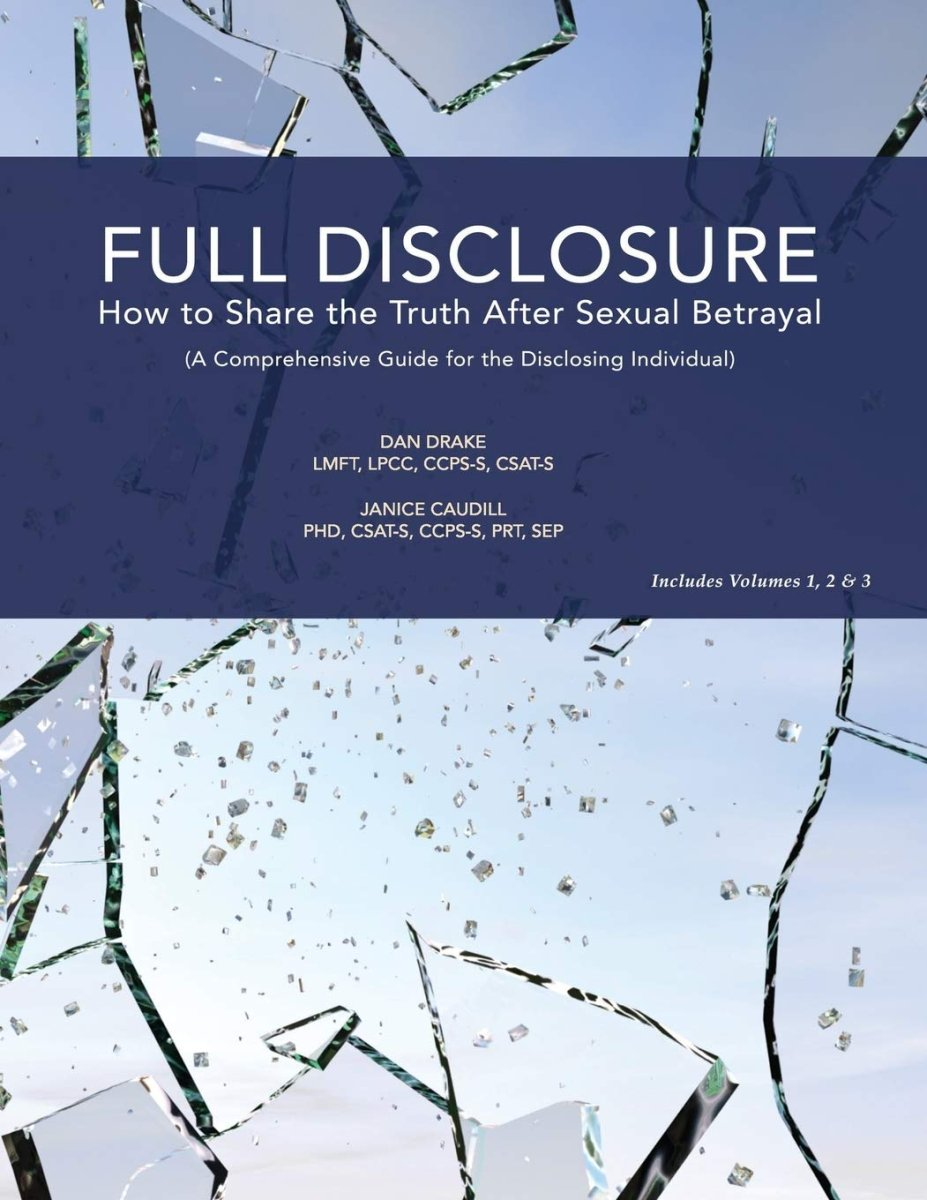
“Have your secret sexual behaviors recently been discovered? Are you stuck in knowing what to share, how much to share, and how to not traumatize your partner with too many gory details about your past? Has your therapist asked you to do a “Formal Disclosure” but you have no idea how to do that? Do you want to begin a life of honesty, integrity, and transparency? IF ANY OF THOSE QUESTIONS APPLY, THIS WORKBOOK IS FOR YOU. This guide walks you through a comprehensive approach to providing a full disclosure of your sexual past to your partner. We help you break down the entire process, offering you a step-by-step approach to sharing your past and restoring a foundation of truth in your relationship. Through examples, questions, and through the shared experiences of others, we’ve created a way for you to navigate a complex, difficult process. Designed to be used with your partner’s companion workbook, “Full Disclosure: Seeking Truth After Sexual Betrayal,” this resource can help you build a new life and relationship that’s based on honesty and integrity.Note: This workbook includes a comprehensive guide to preparing for your Full Disclosure, broken up into three volumes. This includes a guide to help you understand what a disclosure is and if it’s right for you, preparing a disclosure document and preparing for the disclosure session, as well as preparation post-disclosure.”
“Are you preparing for a full disclosure after sexual betrayal? Are you stuck in knowing what to share, how much to share, and how to not traumatize your partner with too many gory details in this full disclosure? If you are looking for tools to better prepare for a full disclosure after sexual betrayal, this workbook breaks down the disclosure-writing process into a comprehensive partner-sensitive 10-step approach. As you follow this guide you will learn to prepare a disclosure document to prepare to your partner after sexual betrayal. This workbook demystifies the disclosure-writing process to better help you prepare for a full disclosure.”
“Based on the latest research of the impact of disclosure, this updated and rewritten edition of Disclosing Secrets presents the best approach for addressing one of the most difficult challenges any sex addict must face – sharing information about his or her sex addiction.”
4. Courageous Love: A Couple’s Guide to Conquering Betrayal by Dr. Stepanie Carnes –
“Leading marriage expert Dr. Stefanie Carnes explains her time-tested strategy to help couples conquer fear and restore their trust, intimacy and connection following a betrayal.
There is nothing that can rupture the loving connection between a couple like betrayal. Courageous Love provides a step-by-step guide for repairing your relationship, whether it is damaged by infidelity, pornography, or compulsive and addictive sexual behavior. Dr. Carnes teaches couples how to respond to one another with compassion and empathy and how to hold onto hope for their relationship.”
The book Courageous Love: A Couple’s Guide to Conquering Betrayal by Dr. Stepanie Carnes has three chapters that focus on the process of disclosure. (Chapter Two: Getting Honest and Chapter 3: Sharing, Listening, and Grieving), and Chapter 4: Emotional Restitution and Amends)
Chapter Two: Getting Honest describes the difference between a dysfunctional disclosure, and a therapeutic disclosure, how to prepare for disclosure ( including a disclosure preparation worksheet with an example), instructions on how to prepare and create your disclosure document, a sample disclosure letter, a description of the betrayed partners role in disclosure, and self-care during and after the disclosure process.
Chapter Three: Sharing, Listening, and Grieving includes Impact Letter Preparation Worksheets, and a sample Impact Letter.
Chapter Four: Emotional Restitution and Amends includes a description of what an emotional restitution is, and a sample Emotional Restitution Letter.
6. Full-Length Coupled Recovery™ Books By Dr. Laney Knowlton, LMFT-S, CSAT-S, CPTT-S, CCPS, CST, CCRDS-S, RAE
“Coupled Recovery® currently includes two sets of books along with a book of the handouts and diagrams connected to the model.
The Coupled Recovery® books explain the process of recovery and walk individuals (and relationships if you are in one) through each step of the process of recovering from problematic sexual behaviors, infidelity, betrayal, betrayal trauma, and patterns of deception. They are written to be read by both betrayers/escapers (this model uses the term “escapers” instead of “addicts” because “escapers” applies to those who are struggling with any level of problematic behaviors) and betrayed partners. The approach used is the Coupled Recovery® model, which connects tools and ideas from current leaders in the fields of problematic sexual behaviors, betrayal trauma, infidelity, sex therapy, and relational counseling. Books 1-3 are a set and focus on early, middle, and late recovery, although each can be read on its own as well. Books 4 and 5 are connected to the Coupled Recovery® model as well, but instead of relating to a specific stage of recovery, they address sub-topics including surviving abandoned betrayal and breaking relational chains related to escape behaviors.
The Coupled Recovery® process will be detailed in a series of five books, the first of which (Facing Hope) is available here. Three of those books are geared towards the recovery process in general. Facing Hope addresses early recovery, which includes discovering truth and creating emotional safety. The second book focuses on middle recovery, helping individuals and couples deepen empathy and connection. The third book in that trilogy looks at late recovery, helping individuals and relationships heal sexuality after betrayal or abuse. The other two books in the set include one that addresses surviving abandoned betrayal and one that helps parents know how to talk to their children as the parents go through the recovery process. As each book becomes available, links to purchase them will be provided.
Facing Hope (available here) focuses on Early Recovery, helping you recover, find, see, and/or share the truth with yourself and those connected to you, or helps support you through the process of discovering and/or understanding the truth about someone you love.”
7. Disclosure Booklets By Dr. Laney Knowlton, LMFT-S, CSAT-S, CPTT-S, CCPS, CST, CCRDS-S, RAE
“The Coupled Recovery® disclosure process is explained in a set of three booklets that walk betrayers and partners through the process step-by-step. This model applies to any level of betrayal, ranging from a single affair to extended patterns of behavior. The process includes four letters: the What & How letter, the Why letter, the Impact letter, and the Amends letter. Letters one, two, and four are written and presented by the betrayer, while letter three is written and presented by the partner. Booklet A is for betrayers and Booklet B is for partners. The first section of each is almost identical and explains the disclosure process in general, including three handouts, one of which breaks the betrayer’s part of the process down into bullet points, another breaks the partner’s process down into bullet points, and a third that explains how to set up the presentation of each letter and what to do on the day of the disclosure. The booklets differ from that point forward.
Booklet A walks betrayers through how to write and present the first two letters, how to receive the third, and how to write and present the fourth. The appendix of Booklet A includes several timelines and exercises that may be helpful for betrayers. These exercises are also available separately in the Exercises Booklet (published primarily for clinicians who want to use the exercises separately). I recommend partners not read Booklet A or go through the Exercises Booklet as the questions and exercises may be unnecessarily triggering.
Booklet A can be purchased on Amazon here.
The Exercises Booklet can be purchased on Amazon here.
Booklet B details the process for partners, explaining how to prepare for and receive the first, second, and fourth letters. Partners are walked through how to process through the stages of grief and write an Impact letter. Every handout and exercise recommended for this process are included in Booklet B, so no additional material is needed and partners need not go through all the questionnaires and exercises developed for betrayers. Note, the Impact letter writing process can be used for any Impact letter, not just one connected to the disclosure process.
Booklet B can be purchased on Amazon here.”
9. Who’s Going to Help me?! Supporting Your Child in a Family Disclosure By Casey M. Allison, APSATS CPC-C –
“As a betrayed wife, mother of nine, and now an APSATS Certified Partner Coach, this is the book and information I needed many years ago when I discovered my husband’s problematic sexual behavior (PSB). PSB impacts every member of our family, and this book is one tool you can use to build a strong foundation for authentic and open communication with your children after betrayal.”
FINANCIAL DISCLOSURE
Financial infidelity refers to the act of being dishonest or deceptive about financial matters within a relationship, typically between romantic partners or spouses.
Financial infidelity can erode trust and create significant strain within a relationship, leading to arguments, resentment, and even separation or divorce if left unresolved. Open communication and honesty about financial matters are crucial for maintaining a healthy and trusting relationship.
Financial Disclosure – What is it?
Financial disclosure related to sex addiction typically refers to the process where individuals with sex addiction issues reveal or provide detailed information about their financial activities and expenditures related to their addictive behaviors. This type of disclosure is often a component of therapy or treatment programs for sex addiction and can serve several purposes:
- Transparency: Financial disclosure allows individuals with sex addiction to be transparent about their financial activities, including spending on pornography, sex workers, online subscriptions, adult entertainment, or other related expenses. This transparency can help build trust between the individual and their therapist, partner, or support group.
- Accountability: By disclosing their financial activities, individuals with sex addiction take responsibility for their behavior and its consequences. This accountability can be an essential step in the recovery process, helping individuals recognize the impact of their actions on themselves and others.
- Identifying Patterns: Financial disclosure helps individuals and their therapists identify patterns of behavior related to sex addiction, such as excessive spending, hidden expenses, or financial enabling of addictive behaviors. Understanding these patterns can inform treatment strategies and interventions aimed at addressing the root causes of the addiction.
- Rebuilding Finances: For individuals whose sex addiction has led to financial problems, such as debt, bankruptcy, or financial strain on relationships, financial disclosure can be a first step towards rebuilding their financial health. By understanding their financial situation, individuals can work towards developing healthier financial habits and repairing any damage caused by their addictive behaviors.
Overall, financial disclosure in the context of sex addiction treatment is aimed at promoting honesty, accountability, and awareness of the financial aspects of the addiction, ultimately supporting individuals in their journey towards recovery and healthier relationships with money and sexuality.
SEE BELOW FINANCIAL DISCLOSURE DIRECTIONS:
Guidance on Disclosure to Adult Children in Intimacy-Disordered Family Systems
Questions about whether to disclose a parent’s sexual betrayal or compulsive behaviors to adult children are both common and significant. Clinical experience and research on the impact of sex addiction within families strongly support thoughtful, therapeutic disclosure to adult children.
Many parents assume their children are unaware of the relational distress in the home. However, decades of therapeutic work—and countless accounts from adult children—demonstrate that this is rarely the case. Even without explicit conversations, children often pick up on secrecy, emotional distance, and unspoken tension long before the truth is addressed.
When a betrayed partner requests disclosure, it is often an appeal for increased accountability, honesty, and relational safety. Continuing to protect a secret can leave the spouse feeling burdened, unheard, and unsafe. Therapeutically, disclosure is understood not as a punitive act but as an important step toward truth-telling, emotional clarity, and family-system repair.
It is crucial to recognize that the harm to children does not begin with disclosure; it begins with deception. Avoiding disclosure may preserve the betrayer’s sense of comfort, but it keeps the family in secrecy and places pressure on others to maintain that secrecy. With careful preparation, clinician collaboration, and trauma-informed pacing, disclosure to adult children can be facilitated in a way that prioritizes safety and healing for everyone involved. Just as significant planning goes into partner disclosures, impact statements, and restitution processes, similar structure and preparation are needed when engaging adult children in intimacy-disordered family systems.
To support healthier outcomes across generations, disclosure to adult children is best viewed not as an optional part of the recovery process but as a meaningful step toward multi-generational healing.
Recommended Resources
Families and clinicians may find the following resources helpful:
- Piper Grant’s workbook, Disclosure & Conversations with Children About Sex Addiction – a practical tool for guiding conversations with children and adult children.
- Dr. Jennifer Freyd’s research on Betrayal Trauma and Betrayal Blindness – essential for understanding why families minimize and how truth-telling restores relational integrity.
- Dr. Omar Minwalla’s work on Systemic Sex Addiction-Induced Trauma (SSA-IT) – highlighting the broader systemic impact of secrecy and relational harm.
Additional Learning Opportunities
An interview with Tara McCausland, Executive Director of S.A. Lifeline, for the 2025 online conference From Surviving to Thriving: Turning Pain into Purpose (November 7–8, 2025), focuses on Creating Safety: The Missing Link in Healing Intimacy-Disordered Family Systems.
Upcoming Resource
A new workbook will be coming out from Culle Vande Garde, LCSW-S, CSAT-S, CPTT, CMAT, PIT, EMDR. It focuses specifically on disclosure to adult children of sex addicts and will be released early next year, along with consultation groups for professionals seeking further guidance.